
$(i)$ $f(x)$ is continuous and defined for all real numbers.
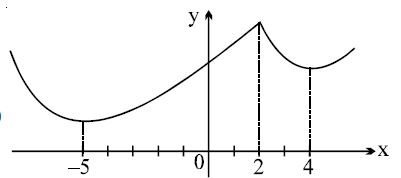
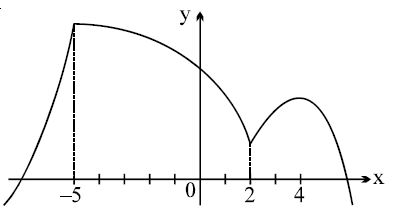
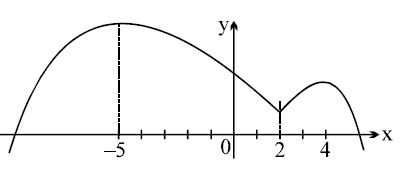
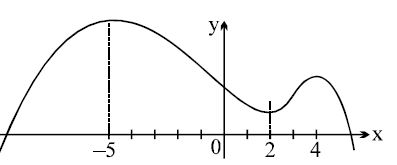
$(ii)$ $f'(-5) = 0$; $f'(2)$ is not defined and $f'(4) = 0$.
$(iii)$ $(-5, 12)$ is a point which lies on the graph of $f(x)$.
$(iv)$ $f''(2)$ is undefined,but $f''(x)$ is negative everywhere else.
$(v)$ The signs of $f'(x)$ are given below:
| $x$ | $(-\infty, -5)$ | $-5$ | $(-5, 2)$ | $2$ | $(2, 4)$ | $4$ | $(4, \infty)$ |
|---|---|---|---|---|---|---|---|
| $f'(x)$ | $+$ | $0$ | $-$ | Undefined | $+$ | $0$ | $-$ |
Possible graph of $y = f(x)$ is:
$(ii)$ $f'(-5) = 0$; $f'(2)$ is not defined and $f'(4) = 0$.
$(iii)$ $(-5, 12)$ is a point which lies on the graph of $f(x)$.
$(iv)$ $f''(2)$ is undefined,but $f''(x)$ is negative everywhere else.
$(v)$ The signs of $f'(x)$ are given below:
| $x$ | $(-\infty, -5)$ | $-5$ | $(-5, 2)$ | $2$ | $(2, 4)$ | $4$ | $(4, \infty)$ |
|---|---|---|---|---|---|---|---|
| $f'(x)$ | $+$ | $0$ | $-$ | Undefined | $+$ | $0$ | $-$ |
Possible graph of $y = f(x)$ is:
- A
- B
- C
- D
Explore More
Similar Questions
Let $f: R \rightarrow (0, \infty)$ be a twice differentiable function such that $f(3) = 18$,$f'(3) = 0$,and $f''(3) = 4$. Then $\lim_{x \rightarrow 1} \left( \log_{e} \left( \frac{f(x+2)}{f(3)} \right)^{\frac{18}{(x-1)^{2}}} \right)$ is equal to:
DifficultJEE MAIN 2026
View SolutionLet $f: R \to R$ be a differentiable function such that $f(2) = 6$ and $f'(2) = \frac{1}{48}.$ Then $\lim_{x \to 2} \int_{6}^{f(x)} \frac{4t^3}{x - 2} dt$ equals
DifficultAIEEE 2005
View SolutionLet $f(x) = \begin{cases} 3-x & \text{if } x < -3 \\ 6 & \text{if } -3 \leq x \leq 3 \\ 3+x & \text{if } x > 3 \end{cases}$. Let $\alpha$ be the number of points of discontinuity of $f$ and $\beta$ be the number of points where $f$ is not differentiable. Then $\alpha+\beta=$
$\mathop {\lim }\limits_{x \to 0} \frac{d}{{dx}}\left( {\frac{{{e^{{e^{{x^2}}}}} - e}}{x}} \right)$ is
The functions $u = e^x \sin x$ and $v = e^x \cos x$ satisfy which of the following equations?
Vedclass Products
For Students
Vedclass Test Series
Mock tests in real JEE/NEET style with performance analysis. 5-day free trial.
Start Free TrialFor Teachers
Exam Paper Generator
Generate Set A/B/C/D exam papers from 7.5L+ questions in 2 minutes. 3 chapters free.
Try FreeFor Institutes
Online Exam Module
Live online exams with unlimited students, 360° analytics & white-label branding.
See Demo